15 August 2008

Full Disclosure...

Explore The Results
How It Works  |  Quiz Comments

PoliticsMatch

Your Political Philosophy
The below is a way of thinking about your political philosophy by dividing your PoliticsMatch answers into "personal" and "economic" questions.  It is only a theory - please take it with a grain of salt!

Personal Questions:  Liberals and libertarians agree in choosing the less-government answers, while conservatives and populists agree in choosing the more-restrictions answers.

Economic Questions:  Conservatives and libertarians agree in choosing the less-government answers, while liberals and populists agree in choosing the more-restrictions answers.
 

Your Score

You scored the following on the PoliticsMatch questions:
 

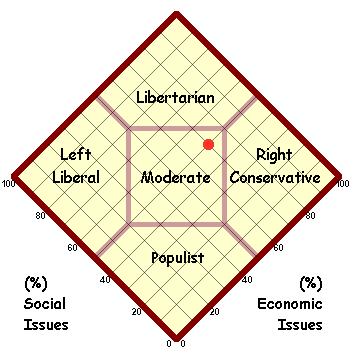
Personal Score 48%
Economic Score 72%
 

Where You Fit In

Where your Personal score meets your Economic score on the grid below is your political philosophy.  Based on the above score, you are a Libertarian Conservative .

Political Map

 
Personal Score

This measures how much you believe government should intervene in people's personal lives. Personal issues include health, love, recreation, prayer and other activities that are not measured in dollars.

  • A high score (above 60%) means you believe in tolerance for different people and lifestyles.
  • A low score (below 40%) means you believe that your standards of morality & safety should be enforced by government. 

Economic Score

This measures how much you believe government should intervene in people's economic lives. Economic issues include retirement funding, budget allocations, and taxes. 

  • A high score (above 60%) means you believe in personal responsibility for your financial matters, and that free-market competition is better for people than central planning by the government. 
  • A low score (below 40%) means you believe that a good society is best achieved by the government redistributing wealth. You believe that government's purpose is to decide which programs are good for society, and how much should be spent on each program.
Examples

The chart below indicates how four "hard-core" political philosophers would answer the questions. From this example, you can see how you fit in with each philosophy.  Your answers are on the left.

  • A "hard-core liberal" would answer personal questions to minimize government involvement, but would answer economic questions to include government intervention.
  • A "hard-core libertarian" would answer both personal and economic questions to minimize government involvement.
  • A "hard-core conservative" would answer personal questions to include government intervention, but would answer economic questions to minimize government involvement.
  • A "hard-core populist" would answer both personal and economic questions with proposals that include government intervention.


= Strongly Support    = Support    = No Opinion    = Oppose    = Strongly Oppose
 

Personal Issues You Hard-core Liberal Hard-core Libertarian Hard-Core Conservative Hard-Core Populist
Abortion Is a Woman's Right
 
Sexual Orientation Protected By Civil Rights Law
 
Teach Family Values in Public Schools
 
Death Penalty
 
Mandatory "Three Strikes" Sentencing Laws
 
Drug Use Is Immoral: Enforce Laws Against It
 
Allow Churches To Provide Welfare Services
 
The Patriot Act harms civil liberties
 

= Strongly Support    = Support    = No Opinion    = Oppose    = Strongly Oppose

Economic Issues You Hard-core Liberal Hard-core Libertarian Hard-Core Conservative Hard-Core Populist
Require Companies To Hire More Women/Minorities
 
More Federal Funding For Health Coverage
 
Privatize Social Security
 
Replace coal and oil with alternatives
 
Decrease overall taxation of the wealthy
 
Illegal immigrants earn citizenship
 
Support and Expand Free Trade
 
Replace US troops with UN in Iraq
 
You Hard-core Liberal Hard-core Libertarian Hard-Core Conservative Hard-Core Populist

= Strongly Support    = Support    = No Opinion    = Oppose    = Strongly Oppose

Issues Not Counted In Philosophy You Hard-core Liberal Hard-core Libertarian Hard-Core Conservative Hard-Core Populist
Absolute Right To Gun Ownership
 
Parents Choose Schools Via Vouchers
 
More Spending On Armed Forces
 
Stricter limits on political campaign funds
 
You Hard-core Liberal Hard-core Libertarian Hard-Core Conservative Hard-Core Populist

= Strongly Support    = Support    = No Opinion    = Oppose    = Strongly Oppose

Final Notes

To ensure balance among political viewpoints, we arranged the wording of the questions so that half the time, the answer involving more government is answered by "support", and half the time by "oppose." Hence, each of the "hard core" philosophers would choose "support" for 3 or 4 of the Personal questions and for 3 or 4 of the Economic questions.

There are four questions which are not counted in your political philosophy. Those questions do not fit this theory -- for example, Democrats typically oppose unrestricted gun ownership, while a 'hard core liberal' would support it on grounds of the government not intervening in a personal issue. These omissions ensure that the theoretical definitions match with current-day politics.

Many of these statements cross over the line between personal issues and economic issues. And many people might answer what we call a "Personal" issue based on economic reasoning. But we have tried to arrange a series of questions which separates the way you think about government activities in these two broad scales.

Political Map and some content from Advocates for Self-Government.


Explore The Results
How It Works  |  Quiz Comments

Pre-Convention Prediction...


At the risk of seeming really foolish - here are my predictions for the November elections in 2008.
 
Popular Vote
  • McCain - 53%
  • Obama - 44%
  • Independent / Other - 3%
I predict Obama to carry Illinois and New York but no other states of consequence.  
 
Why?  Well, dear reader(s), it stems from the simple fact that the nation would rather stand with the known and experienced than the unknown and inexperienced.  I respect Senator Obama's capability to be a good president.  But that's me.  Multiply any personal uncertainty by the population of voters and you have a smoothing effect which places the advantage squarely in McCain's court.    Short of selecting Vladimir Putin as VP, I think the Arizona senator is on the ascendant.
 
Wedge issues are not in play here.  Gun control was taken off the table by the Supreme Court.  The Iraq war is transitioning well.  There is a real risk the economy will improve, as it tends to do in the fourth quarter.  Finally, the behavior of Russia in Georgia will underscore the real threats existent in the world and the role of the United States as the ONLY real bulwark against unchecked aggression, although I am disappointed at our "public" response.
 
So, mark your calendars and place your wagers.  I have been known to make wild bets and lose them gloriously.  As a good friend of mine advised, go big or go home.
 

13 August 2008

Stratfor is on target...


The analytical piece by Stratfor's George Friedman is right on the money in regard to Russia's actions and motivations.

Now, what are we going to do about it?

Europe must make a decision as to how they are going to react to the Russian move. I suspect there are plenty of heads of states who are thinking about voters and rising natural gas prices.

They better get their pipline built - and a few main battle tanks wouldn't hurt.

The game continues.

11 August 2008

How to help Georgia...

Photo Reuters - Civilians Flee Homes

The Russians continue to show their brutal, thuggish approach to geopolitics. On one hand, they settle a decades old conflict with the People's Republic of China by solidifying their border with the only remaining communist superpower. On the other hand, they plunge into a pro-western, neighboring state with the equivalent strength of a mechanized division. The mismatch between Russia and Georgia is laughable. Georgia has no combat airpower, no naval presence to speak of on the Black Sea and a standing army of some 26,000. Russia has invaded with six times the total number of main battle tanks as are in the Georgian inventory. Georgia has been involved in a battle for the retention of two critical regions, South Ossetia and Abkhazia. Both regions border Russia with the latter bordering the Black Sea as well. Georgia's southern neighbor, Turkey, would hardly welcome a Russian proxy state on its northern border or thousands of refugees from yet another war torn region.

Georgia had been moving towards a very successful Westernization and conversion from the old, corrupt Soviet system. The two pronged invasion by Russian forces sends a chilling message to Ukraine and other nation states. Europe is absolutely apoplectic with fear. Had Georgia's membership in NATO been secured six months ago, this event would likely have never occurred. An attack like this would have brought a response along these lines;

1) United States nuclear attack submarines would penetrate the Black Sea and neutralize Russian Naval assets through interdiction or sinking.
2) NATO air assets from Italy, Turkey and other bases would provide air cover for Georgian forces.
3) GPS weaponry would be employed to execute SEAD missions (suppression of enemy air defense)
4) NATO SOF teams would be inserted to conduct fire missions against any Russian forces.
5) Ground forces from NATO would be mobilized as a stabilizing force against Russian forces
6) A possible declaration of war would follow against Russia by NATO

After that - it could get messy.

Vladimir Putin, the real power behind the Russian government remains a thuggish threat to anti-corruption, free market nations. It is clearly his planned and executed operation which unleashed these forces against an essentially helpless civilian population. There are commentators who make ridiculous comparisons to our invasion of Iraq and Afghanistan. The absurdity and post-modern relativism applied in this argument is repugnant. The run up to each of these military actions was well known, communicated and executed in a legal fashion (as legal as war can get).

Russia retains all of its historical bullying and disregard for the rule of law as it ever has. It is partly the fault of nations in Europe who have failed to challenge their largest neighbor for its reprehensible behavior.

Latest: News on Georgia

04 August 2008

How the internet is changing the rules...


Joss Whedon created Buffy the Vampire Slayer and my favorite, gritty SciFi series, Firefly. Here he presents the very funny Neal Patrick Harris in a delightful online only video.

Military Rules...

Provided me by a good friend and USMC brat. They generally seem to apply, and I am in a humorous mood today.

Military Rules

Marine Corps Rules:

1. Be courteous to everyone, friendly to no one.

2. Decide to be aggressive enough, quickly enough.

3. Have a plan.

4. Have a back-up plan, because the first one probably won't work.

5. Be polite. Be professional. But, have a plan to kill everyone you
meet.

6. Do not attend a gunfight with a handgun whose caliber does not start
with a '4.'

7. Anything worth shooting is worth shooting twice. Ammo is cheap. Life
is expensive.

8. Move away from your attacker. Distance is your friend. (Lateral &
diagonal preferred.)

9. Use cover or concealment as much as possible.

10... Flank your adversary when possible. Protect yours.

11... Always cheat; always win. The only unfair fight is the one you
lose.

12... In ten years nobody will remember the details of caliber, stance,
or tactics. They will only remember who lived.

13... If you are not shooting, you should be communicating your
intention to shoot.


Navy SEAL's Rules:

1. Look very cool in sunglasses.

2. Kill every living thing within view.

3. Adjust Speedo.

4. Check hair in mirror.


US Army Rangers Rules:

1. Walk in 50 miles wearing 75 pound rucksack while starving.

2. Locate individuals requiring killing.

3. Request permission via radio from 'Higher' to perform killing.

4. Curse bitterly when mission is aborted.

5. Walk out 50 miles wearing a 75 pound rucksack while starving.


US Army Rules:

1. Curse bitterly when receiving operational order.

2. Make sure there is extra ammo and extra coffee.

3. Curse bitterly.

4. Curse bitterly.

5. Do not listen to 2nd LTs; it can get you killed.

6. Curse bitterly.


US Air Force Rules:

1. Have a cocktail.

2. Adjust temperature on air-conditioner.

3. See what's on HBO.

4. Ask 'What is a gunfight?'

5. Request more funding from Congress with a 'killer' Power Point
presentation.

6. Wine & dine ''key' Congressmen, invite DOD & defense industry
executives.

7. Receive funding, set up new command and assemble assets.

8. Declare the assets 'strategic' and never deploy them operationally.

9. Hurry to make 13:45 tee-time.

10. Make sure the base is as far as possible from the conflict but close
enough to have tax exemption.


US Navy Rules:

1. Go to Sea.

2. Drink Coffee.

3. Deploy Marines

Go Navy !


24 July 2008

The law is a good thing...


>

It is a wafer thin barrier between humanity and its most basic and feral instincts.  Someone cut you off in traffic?  You may experience that primal urge to accelerate your Smart Car into the side of that Hummer H2 in a rage blind act of retaliation.  But you don’t.  It could be because of the state trooper you notice at the side of the road, the thought of a substantial hike in your insurance rate or some other mitigating reason.  Rarely is it because the simple weight ration between the offending behemoth and your egalitarian chariot would result in near instantaneous squishiness.


And so it is laws and covenants which keep us from behaving in a totally self interested manner.  Failing the existence of credible laws we would be seeking only to give succor to our individual basic instincts.  With proper societal pressures in place we defer this urge and cooperate.  It is in times of stress and extreme conditions that the barriers stretch and “crimes” occur.  We all have heard the phrase “crime of passion” in which one individual responds to their instinctive reflex and acts in a criminal manner.  It is hard to conceive of a world in which laws are an unnecessary legacy.  Even today, laws exist which are holdover from times in which they were used to control or oppress a population.  Iran still stones “adulterers”, India prosecutes homosexuals, China imprisons dissidents and counties in the United States forbid the sale of alcohol on Sunday.


We are thus enfolded by laws, rules and regulations.  Many of which we are blissfully unaware.


            “Excuse me guvnor, you aware that your article of clothing is in violation of article three section one paragraph A, prohibiting disrespectful display of her Royal Majesty?”


Right, off to jail then.


But there are crimes for which we are keenly aware.  These tend to be very big events.  They are murder, assault, rape and the like.  These crimes, which when committed by a civilian, are terrible; and yet when committed by the soldiery of a nation are completely detestable.  Why is that?  At one point in our existence it was considered a spoil of war for attacking bands to take whatever they wanted.  Vikings were renowned for their warlike deeds of rape and pillage.  Soldiers appropriated property, enslaved populaces and generally did as they pleased.  These violations enter into the realm of war crimes.  There is a good BBC News Article on the topic.


With the handover and arrest, I can not call it a capture, of Radovan Karadzic by Bosnian Serb authorities, the topic of war crimes is resurrected again.  He was one of three active architects responsible for the hell that Yugoslavia devolved into in the 1990s.  Like most international issues, it is complex and not easily understood.  A group of passionate advocates on the left routinely call for the indictment and prosecution of the current President and administration of the United States of America under the aegis of war crimes.  They are misled in their accusations and have been (as Marx noted so correctly) useful idiots.


In 1863, with the issuance of the Lieber Code by Union forces of the United States, the first written protection of innocents and civilians in conflict was defined.  It was not until 1899 that the world began serious discussions on the behavior of armed forces in times of war.  Previously the only international rule was an unstated acknowledgement to chivalric code, in which innocents should not be harmed.  The operative word here is “should”.  The Napoleonic conflict and countless wars in the 19th century reminded the world of the ability of humanity to inflict suffering upon one another.  In World War I, the widespread use of chemical weapons, aerial bombardment and other modern inventions earned the conflict the moniker “the war to end all wars”.  Sadly, this was only wishful thinking.    


Nevertheless, the world forged ahead.  It worked hard, especially after World War II to refine and strengthen the laws of conflict.  The UN was established in the wake of the fading League of Nations.  And yet acceptable conduct from belligerents has been elusive.  The United Kingdom waged a brutal conflict on the northern edge of the emerald isle for decades.  In Cambodia, Pol Pot slaughtered millions.  In Rwanda civilians were incited to take up arms against their own brethren in an orgy of violent tribalism.  And still the world trudged onwards, working to establish clear codes of conduct and behavior for governments when diplomacy turned from the point of a pen to the end of a sword.


This was not an easy path to navigate.  Even as late as 1996, the International Court of Justice had difficulty forming an opinion on the use of nuclear weapons.  I think it is safe to say that the use of such devices is generally considered bad.  And to use them in an unprovoked manner, would be the definition of a criminal act.  Action in response to such an attack, however, is not so clear.


E. By seven votes to seven, by the President's casting vote,

It follows from the above-mentioned requirements that the threat or use of nuclear weapons would generally be contrary to the rules of international law applicable in armed conflict, and in particular the principles and rules of humanitarian law;

However, in view of the current state of International Law, and of the elements of fact at its disposal, the Court cannot conclude definitively whether the threat or use of nuclear weapons would be lawful or unlawful in an extreme circumstance of self-defence, in which the very survival of a State would be at stake;

IN FAVOUR: PRESIDENT Bedjaoui, JUDGE Renjeva, Herczegh, Shi, Fleischhauer, Vereschetin, Ferrari Bravo;
AGAINST: VICE-PRESIDENT Schwebel; JUDGES: Oda. Guillaume, Shahabuddeen, Weeramantry, Koroma Higgins.

F. Unanimously,

There exists an obligation to pursue in good faith and bring to a conclusion negotiations leading to nuclear disarmament in all its aspects under strict and effective international control.

            Reference - International law links


Where are we now? 


The United States, for reasons of its own, is not one of the one hundred and seven signatories to the Rome Statute, convening the International Criminal Court.  They, along with eighty-nine other nations, have not endorsed the court’s broad powers.  If acceptance by 54% of the world’s nations (only by count not population as Russia, India and China also remain unsigned) is endorsement, then it is a slim one indeed.  Almost all of these agreements, treaties, resolutions and other high-minded documents are exclusively applicable to nation states.  To date, there is very little governing the behavior of non-state actors (i.e. Al-Qaeda, etc.).  Their actions tend to fall into garden variety criminal acts and thus not subject to the same rules of behavior as nations.


How do we, as a nation, respond?  My JAG officer would chide me and remind me that it doesn’t matter whether they are playing fair, we have rules to follow.  I was amazed at this friend of mine’s workload in the 5th Fleet Area of Operational Responsibility.  He was a Navy Commander and served as the combatant commander’s (COCOM) JAG.  Eighteen hour days were short ones and routinely he spent nights at the command center preparing analysis, briefs and responding to crises.


On his door was a poster, it showed a carrier battle group deploying towards the horizon.  Below it was the phrase “don’t go to war without your lawyer”.  It reminded us all that we act as a nation.  And as a nation we have a set of laws to uphold and abide.  After all, it is to the Constitution to which the military swears its allegiance – not the government.


I just wonder what poster our opponents have on their wall.

15 July 2008

The Great Supplement Swindle...


I work on a regulated industry.  My civilian career is governed by organizations like the FDA, EPA, OSHA and others too numerous to mention.  Routinely my facility is inspected, scrutinized and I have even had to submit information to congressional committees.  This, I believe, is a good thing.  Someone needs to watch over the firms providing public services.  It is reasonable to check on airlines, food producers and others who possibly could affect the health and welfare of the public at large.  There is a lot of pressure to take short cuts to preserve profits, maintain competitiveness and sustain one's business.  VLC's (Very Large Corporations) are under intense scrutiny to comply.  They represent deep pockets and consumers routinely target them with litigation, complaints and queries. 
 
The sheer size and scale of the modern corporation is such that it presents a monolithic appearance to the outside world.  It can appear impersonal and intimidating.  Past performance of some firms in the 1970s and earlier has been less than perfect in the stewardship of their constituency.  Even today, scandals rocking the financial world engender a deep distrust of corporate entities.  Without sounding too much like a spokesperson for the entire corporate culture, let me offer some observations from inside.
 
Earlier in my career I worked for a multi-national which got involved in a consumer safety issue.  Unlike Johnson and Johnson's handling of the Tylenol crisis, this firm took a far more hands off approach to a real threat to its integrity.  As such, the market punished this firm ruthlessly (more than half its market share evaporated overnight) and it was acquired by another firm which collected the remains of a once dominant company.  This occurred almost two decades ago, long before the instantaneous transmission of information via the internet and the twenty-four hour news cycle. 
 
In the 21st century, corporations are being held to increasingly strict standards of behavior.  Consumers are better equipped than ever and information is only a keystroke away.  And yet there exists a remaining realm of shadowy uncertainty.  Within the United States, nutritional supplements are a realm of para-regulated products which may (or may not) be helpful to the public.  Websites promising fantastic results tread the line between deception and marketing.  Each of these products is marketed with the standard disclaimer that the products' claims have not been evaluated by the FDA nor is their product designed to treat, cure or diagnose any disease.  As a consumer, I would stop and rethink my purchase based upon such a caveat.  And yet the supplement industry is a multi-billion dollar enterprise. 
 
Many supplements are manufactured by major pharmaceutical firms (Bayer, etc.).  Some are produced by large, standalone supplement companies such as Boiron.  These companies report expenditures to the financial markets in similar formats.  What is noted is the gap between R&D spending for the traditional pharmaceutical (also known as Big Pharma - oooh, can't you feel the evil!!) and supplement only companies.  In most cases, the sales and advertising dollars are disproportionately high among the supplement only companies.  Why is this?  Wouldn't you expect that these firms would be researching new products, providing benefits to their customers, on a regular basis?
 
The simple fact is often that there is no research because their is no good effect (typically there is no negative effect either).  The supplement only companies sell hope in a pill, elixir, tincture or powder.  Sometimes there is some basic research to support claims - the body needs vitamins, for example - but most often the claims are vague or even misstated.  These firms count on the public's ignorance of science and desire for self-improvement not involving traditional hard work (diet and exercise) or acknowledgement of a real medical issue (depression, etc.).  Whole industries have sprung up preying upon the public suspicions of traditional institutions.  In most cases these industries are loosely or un-regulated.  They are quick to fan the flames of doubt and dissatisfaction but even quicker to divert objective analysis of their own offerings.
 
Next time you go grocery shopping, walk down the supplement aisle.  Take some time and really peruse the labels of what is offered for sale.  Look at the manufacturer's claims and then apply a little of Occam's Razor to them. 
 
Remember, if it sounds too good to be true - it probably is.